
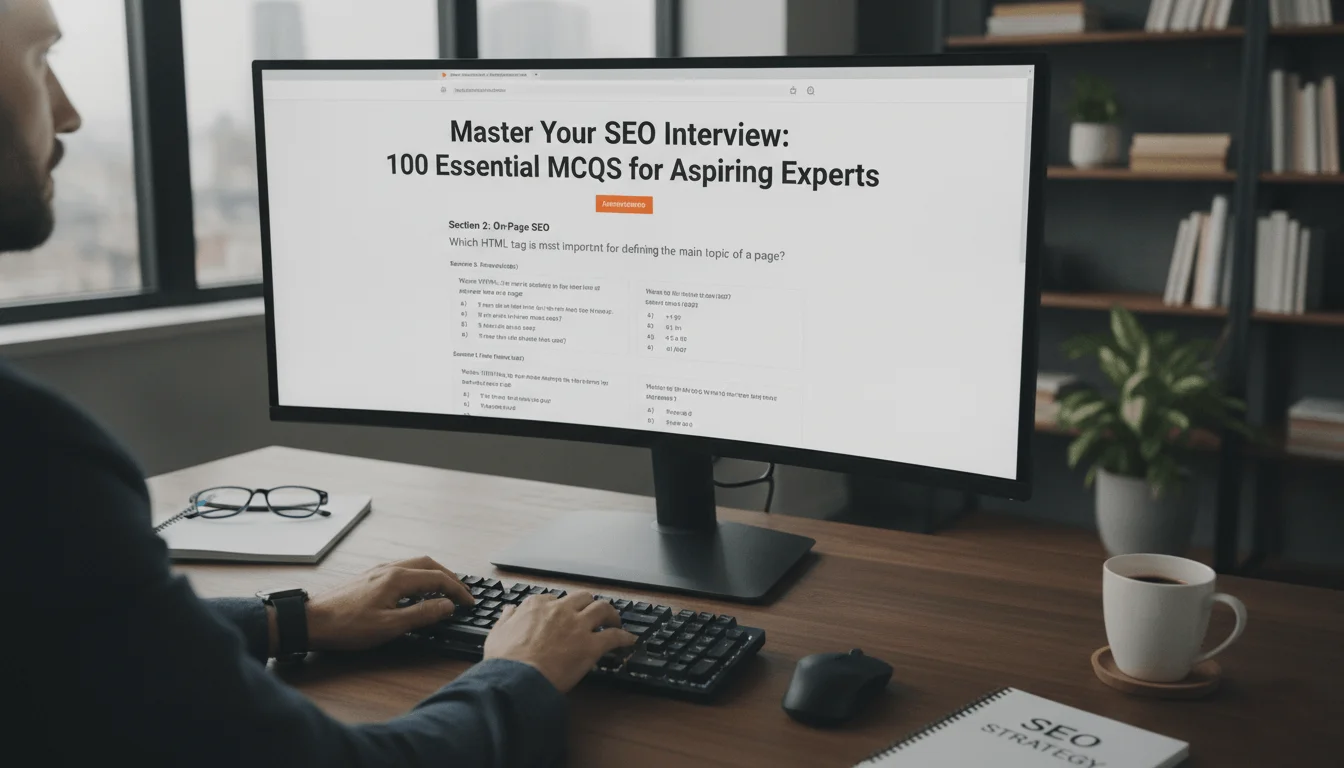
Are
you ready to elevate your SEO career? Whether you're aiming for a new
role, looking to refresh your knowledge, or simply want to solidify your
understanding of search engine optimization, mastering the fundamentals
(and beyond) is crucial. In the fast-paced world of digital marketing,
staying updated and demonstrating a deep understanding of SEO principles
can set you apart. This
comprehensive guide presents 100 multiple-choice questions designed to
test your SEO expertise. These questions cover a wide range of topics,
from on-page and off-page SEO to technical SEO, analytics, and the
latest algorithm updates. Think of this as your personal challenge to
sharpen your skills and confidently approach any SEO interview. Each question comes with a correct answer, helping you understand not just what the answer is, but also providing an opportunity to delve deeper into why it's correct. Let's dive in and prove your mettle! Section 1: SEO Fundamentals & Basics What does SEO stand for? Which of the following is NOT a core component of SEO? What is the primary goal of SEO? What is a "keyword" in SEO? What is "SERP" an acronym for? Section 2: On-Page SEO Which HTML tag is most important for defining the main topic of a page? What is the ideal length for an SEO-friendly title tag? What is the purpose of a meta description? Which of the following is a good practice for internal linking? What role do "alt text" attributes play in SEO? Why is content quality important for On-Page SEO? What is "keyword stuffing"? Which factor primarily influences readability on a webpage? What is the significance of URL structure in On-Page SEO? What are header tags (H1, H2, H3, etc.) primarily used for? Section 3: Off-Page SEO What is the most critical aspect of Off-Page SEO? What is a "backlink"? Which of the following is considered a "white hat" link building strategy? What is "anchor text"? What does "domain authority" (DA) refer to? Why is the quality of backlinks more important than the quantity? What is "nofollow" attribute used for in backlinks? Which of these is NOT a common off-page SEO activity? What is the main benefit of obtaining backlinks from high-authority websites? What is considered a "black hat" SEO tactic related to link building? Section 4: Technical SEO What is a "sitemap" (XML Sitemap) primarily used for? What does "robots.txt" file do? What is the importance of a "canonical tag"? Why is website speed important for SEO? What does "mobile-first indexing" mean? What is "schema markup"? What is the primary purpose of an HTTPS protocol? What is a 301 redirect used for? How does "hreflang" attribute help in SEO? What is the main goal of "crawl budget optimization"? Section 5: Keyword Research What is the first step in effective keyword research? What are "long-tail keywords"? Which of these metrics is NOT typically used in keyword research? Why is "user intent" crucial in keyword research? What is a "seed keyword"? Which tool is commonly used for keyword research? What is "keyword difficulty" (KD) or "SEO difficulty"? What is the benefit of targeting keywords with lower search volume but high relevance? What is a common pitfall to avoid during keyword research? How does competitor analysis aid keyword research? Section 6: Local SEO What is the primary platform for Local SEO? What does "NAP" stand for in Local SEO? What are "local citations"? Why are customer reviews important for Local SEO? What is a "local pack" (or "3-pack") in Google search results? How does proximity to the searcher's location affect local rankings? Which of the following is a key element of optimizing your Google My Business profile? What is the role of structured data (schema markup) in Local SEO? Why is having a consistent NAP across all online platforms important for Local SEO? What is the primary goal of Local SEO? Section 7: SEO Analytics & Reporting Which tool is essential for tracking website traffic, user behavior, and conversions? What does "Bounce Rate" indicate in Google Analytics? What is "Organic Search Traffic"? Which Google tool helps you monitor your site's performance in Google Search results and troubleshoot indexing issues? What are "impressions" in Google Search Console? What does "Click-Through Rate" (CTR) signify in SEO? What is the primary benefit of tracking "conversions" in Google Analytics? What is a "dashboard" in Google Analytics used for? When reporting on SEO performance, which metric would you use to show the improvement in visibility? What kind of data can "Behavior Flow" reports in Google Analytics provide? Section 8: Advanced SEO Concepts & Algorithm Updates What is the primary purpose of Google's E-A-T concept? What was the main impact of Google's "Panda" algorithm update? What was the main target of Google's "Penguin" algorithm update? What is "Voice Search Optimization" primarily concerned with? What is "Featured Snippet" in SERP? What does "Core Web Vitals" measure? Why is "semantic SEO" becoming increasingly important? What is the significance of "entities" in modern SEO? What is "programmatic SEO"? How do AI and Machine Learning (e.g., RankBrain, BERT, MUM) impact SEO? Section 9: SEO Tools & Technologies Which of these is primarily an on-page SEO analysis tool? Which tool would you use to analyze competitor backlink profiles? What is the primary function of Screaming Frog SEO Spider? What is Google Tag Manager used for in an SEO context? What is the main benefit of using a Content Delivery Network (CDN) for SEO? Which tool is best for identifying technical SEO issues like crawl errors and indexing problems? What is the role of browser developer tools (e.g., Chrome DevTools) in SEO? Which
of the following is an open-source platform widely used for website
content management and has strong SEO capabilities with plugins? What is the purpose of a Rank Tracker tool? Which tool helps with conducting A/B testing for landing pages? Section 10: General SEO Best Practices & Ethics What is "white hat" SEO? What is "black hat" SEO? Why is user experience (UX) increasingly important for SEO? What is "evergreen content"? What is "content syndication" in the context of SEO? What is the biggest risk of using "black hat" SEO techniques? What is "disavowing" links used for? How does competitor analysis benefit your overall SEO strategy? Why is continuous learning vital in SEO? What is "semantic search"? What is the primary purpose of an "SEO audit"? How does HTTPS impact SEO? What is a key indicator of a healthy backlink profile? What is the role of a "content gap analysis" in SEO? Ultimately, what is the best approach to sustainable SEO success? Congratulations
on making it through all 100 questions! This comprehensive quiz covers a
vast landscape of SEO knowledge, from foundational concepts to advanced
strategies and ethical considerations. A strong performance here
indicates a solid understanding of what it takes to succeed in the
ever-evolving world of search engine optimization. Remember,
SEO is a continuous journey of learning and adaptation. Staying
curious, experimenting with new techniques, and keeping up with industry
changes are key to maintaining your edge as an SEO expert. Use this
quiz as a stepping stone to further your knowledge and confidently
tackle your next big SEO challenge or interview. Good luck! Q1: How often do search engine algorithms change? Q2: Is social media a direct ranking factor for SEO? Q3: What's the difference between SEM and SEO? Q4: How long does it take to see SEO results? Q5: Should I focus more on On-Page or Off-Page SEO?Master Your SEO Interview: 100 Essential MCQs for Aspiring Experts
The 100 Essential SEO MCQs: Test Your Knowledge!
a) Search Engine Optimization
b) Search Engine Operation
c) Site Engine Optimization
d) System Engine Optimization
Answer: a)
a) On-page SEO
b) Off-page SEO
c) Technical SEO
d) Social Media Marketing
Answer: d)
a) To get more social media followers
b) To improve a website's visibility in search engine results
c) To run paid advertising campaigns
d) To design visually appealing websites
Answer: b)
a) A password for your website
b) A term or phrase that users type into search engines
c) A programming language
d) A type of website design
Answer: b)
a) Search Engine Ranking Process
b) Search Engine Result Page
c) Site Engagement Rating Protocol
d) Standardized Electronic Ranking Procedure
Answer: b)
a) <p>
b) <h1>
c) <a>
d) <div>
Answer: b)
a) 10-20 characters
b) 30-40 characters
c) 50-60 characters
d) 100+ characters
Answer: c) (approx. 50-60 characters before truncation)
a) It directly impacts search engine ranking
b) It provides a summary of the page content to searchers
c) It's only visible to website administrators
d) It defines the website's color scheme
Answer: b)
a) Linking only to your homepage
b) Using descriptive anchor text
c) Having no internal links at all
d) Linking to irrelevant pages
Answer: b)
a) They define the font style of images
b) They provide a text description for images, aiding accessibility and search engines
c) They link images to other websites
d) They compress image file sizes
Answer: b)
a) It helps in keyword stuffing
b) High-quality content engages users and earns natural backlinks
c) It makes the website load faster
d) It allows for more images on a page
Answer: b)
a) Optimizing a page with relevant keywords
b) Overusing keywords in content in an attempt to manipulate rankings
c) Researching new keywords
d) Analyzing competitor's keywords
Answer: b)
a) The number of images
b) Use of short paragraphs, headings, and clear language
c) The website's hosting provider
d) The amount of technical jargon
Answer: b)
a) It only affects website aesthetics
b) It helps search engines understand page hierarchy and content
c) It determines the website's loading speed
d) It is irrelevant for SEO
Answer: b)
a) To define bold text
b) To structure content and indicate hierarchy
c) To embed videos
d) To create bulleted lists
Answer: b)
a) Website design
b) Link building (backlinks)
c) Content writing
d) Image optimization
Answer: b)
a) A link from your website to another website
b) A link from another website to your website
c) A link within your website to another page on your website
d) A broken link
Answer: b)
a) Buying links
b) Guest blogging on reputable sites
c) Participating in link schemes
d) Using automated link generation tools
Answer: b)
a) The text that surrounds a link
b) The clickable text in a hyperlink
c) The URL of a link
d) The title of a webpage
Answer: b)
a) The age of a website's domain
b) A search engine ranking score developed by Moz that predicts how likely a website is to rank in SERPs
c) The number of pages on a website
d) The speed of a website
Answer: b)
a) Search engines only count high-quality links
b) High-quality links from relevant, authoritative sites pass more "link juice"
c) Quantity of links can lead to penalties
d) Quality links are easier to acquire
Answer: b)
a) To tell search engines to follow the link
b) To instruct search engines not to pass authority through the link
c) To make the link appear bold
d) To open the link in a new tab
Answer: b)
a) Social media marketing
b) Local SEO citations
c) Content creation
d) Influencer outreach
Answer: c) (Content creation is primarily On-Page, though it fuels off-page efforts)
a) It guarantees higher rankings immediately
b) It signals trustworthiness and authority to search engines
c) It increases website traffic directly
d) It makes your website load faster
Answer: b)
a) Earning links naturally through great content
b) Participating in link exchange programs (reciprocal linking)
c) Creating private blog networks (PBNs) to artificially inflate link profiles
d) Disavowing spammy links
Answer: c)
a) To visually display the website structure to users
b) To help search engines discover and crawl all important pages on a website
c) To store website analytics data
d) To manage website security
Answer: b)
a) It defines the website's CSS styles
b) It tells search engine crawlers which parts of a website to access or ignore
c) It manages website redirects
d) It stores user information
Answer: b)
a) It tells search engines to ignore a page
b) It specifies the preferred version of a URL when multiple URLs have identical or very similar content
c) It speeds up page loading time
d) It encrypts website data
Answer: b)
a) It directly correlates with the number of backlinks
b) Faster sites provide a better user experience and are favored by search engines
c) It only affects mobile users
d) It is irrelevant for desktop rankings
Answer: b)
a) Google primarily uses the desktop version of a website for indexing and ranking
b) Google primarily uses the mobile version of a website for indexing and ranking
c) Websites should only be designed for mobile devices
d) Mobile responsiveness is no longer important
Answer: b)
a) A type of website hosting
b) A form of structured data vocabulary that helps search engines better understand the content of a page
c) A design framework for websites
d) A tool for keyword research
Answer: b)
a) To make websites load faster
b) To provide secure communication over a computer network
c) To improve image compression
d) To manage external links
Answer: b)
a) To temporarily move a page
b) To permanently move a page from one URL to another, passing most of the link equity
c) To block search engine crawlers
d) To display an error message
Answer: b)
a) It defines the primary language of a website
b) It informs search engines about the language and geographical targeting of a page
c) It encrypts website content
d) It speeds up image loading
Answer: b)
a) To increase the number of pages on a website
b) To ensure search engine crawlers efficiently discover and index important pages
c) To reduce the number of internal links
d) To prevent website errors
Answer: b)
a) Analyzing competitor backlinks
b) Understanding your target audience and business goals
c) Building a list of long-tail keywords
d) Checking keyword difficulty
Answer: b)
a) Very broad, single-word keywords
b) Shorter, highly competitive keywords
c) Longer, more specific phrases with lower search volume but higher conversion rates
d) Keywords that are no longer relevant
Answer: c)
a) Search Volume
b) Keyword Difficulty
c) Cost Per Click (CPC)
d) Website Color Palette
Answer: d)
a) It helps you write more content
b) It ensures your content addresses what users are truly looking for
c) It determines the website's design
d) It dictates the number of images on a page
Answer: b)
a) A keyword used in paid advertising
b) A broad term that forms the basis for further keyword research
c) A keyword with very low search volume
d) A keyword that is no longer trending
Answer: b)
a) Adobe Photoshop
b) Google Keyword Planner
c) Microsoft Excel
d) Zoom
Answer: b)
a) How hard it is to type a keyword
b) A metric indicating how challenging it is to rank for a particular keyword
c) The number of words in a keyword
d) The cost of advertising for a keyword
Answer: b)
a) They are easier to rank for and can drive highly qualified traffic
b) They guarantee a spot in the featured snippet
c) They are always free to advertise for
d) They increase website speed
Answer: a)
a) Focusing only on high-volume keywords
b) Ignoring long-tail keywords
c) Not considering user intent
d) All of the above
Answer: d)
a) It helps you copy their website design
b) It reveals keywords they are ranking for and opportunities you might be missing
c) It tells you their website's hosting provider
d) It is irrelevant to keyword research
Answer: b)
a) Facebook
b) Google My Business
c) Twitter
d) LinkedIn
Answer: b)
a) Name, Address, Phone Number
b) Network, Access, Protocol
c) Navigation, Analytics, Pages
d) News, Articles, Promotions
Answer: a)
a) Links from local news websites
b) Mentions of your business's NAP on other websites (directories, review sites)
c) Quotes from local customers
d) Social media posts by local businesses
Answer: b)
a) They directly impact your website's domain authority
b) They build trust and influence local search rankings
c) They are irrelevant to local search
d) They only affect social media engagement
Answer: b)
a) A paid advertising block
b) A prominent section displaying local businesses relevant to the search query
c) A collection of related images
d) A list of news articles
Answer: b)
a) It has no effect
b) It is a significant ranking factor for local searches
c) It only affects mobile users
d) It only matters for national businesses
Answer: b)
a) Using stock photos exclusively
b) Filling out all sections completely and accurately, including categories, hours, and services
c) Avoiding responding to reviews
d) Only listing your website, not your address
Answer: b)
a) It helps create website designs
b) It provides specific information about your business (e.g., address, opening hours) to search engines in a structured format
c) It helps compress images
d) It manages social media posts
Answer: b)
a) It helps prevent spam
b) It builds trust with search engines and avoids confusion
c) It increases website traffic directly
d) It is only relevant for large corporations
Answer: b)
a) To rank nationally for all keywords
b) To attract customers from a specific geographic area
c) To generate leads from social media
d) To improve website speed globally
Answer: b)
a) Google Docs
b) Google Analytics
c) Microsoft Word
d) Adobe Acrobat
Answer: b)
a) The number of times users return to your site
b) The percentage of single-page sessions (users who leave your site from the entry page without interacting further)
c) The speed at which users leave your site
d) The number of pages viewed per session
Answer: b)
a) Traffic from paid advertisements
b) Traffic that comes to your website from unpaid search engine results
c) Traffic from social media
d) Direct traffic to your website
Answer: b)
a) Google Ads
b) Google My Business
c) Google Search Console
d) Google Drive
Answer: c)
a) The number of clicks your listing received
b) The number of times your site appeared in search results
c) The average position of your listing
d) The number of users who visited your site
Answer: b)
a) The number of times users click on internal links
b) The percentage of people who see your listing in SERP and click on it
c) The rate at which users bounce from your site
d) The speed of your website
Answer: b)
a) To understand which SEO efforts are driving valuable actions (e.g., sales, sign-ups)
b) To improve website design
c) To track social media engagement
d) To identify broken links
Answer: a)
a) To create new web pages
b) To provide a quick, summarized view of key metrics and reports
c) To manage website security
d) To write blog posts
Answer: b)
a) Bounce Rate
b) Average Session Duration
c) Organic Search Traffic and Keyword Rankings
d) Page Load Speed
Answer: c)
a) Information about website errors
b) Visual representation of the paths users took through your site
c) Details about competitor websites
d) Keyword research data
Answer: b)
a) To evaluate the design of a website
b) To assess the Expertise, Authoritativeness, and Trustworthiness of content and websites
c) To measure website loading speed
d) To determine social media engagement
Answer: b)
a) To penalize websites with slow loading times
b) To target low-quality content and "thin content" sites
c) To improve mobile search results
d) To focus on local search queries
Answer: b)
a) To improve the relevance of search results
b) To penalize websites with manipulative link schemes and unnatural backlinks
c) To focus on user experience
d) To enhance image search
Answer: b)
a) Optimizing websites for visually impaired users
b) Optimizing content to rank for spoken queries, often longer and more conversational
c) Using audio files on websites
d) Improving website speed for voice assistants
Answer: b)
a) A paid advertisement at the top of the search results
b) A selected search result that is displayed at the top of Google's organic results below the ads, often pulled from a web page
c) A list of related images
d) A section for news updates
Answer: b)
a) The number of backlinks to a website
b) Key aspects of user experience on a web page, including loading, interactivity, and visual stability
c) The relevance of content to keywords
d) The accuracy of website data
Answer: b)
a) It focuses on exact keyword matches
b) Search engines are moving towards understanding the context and meaning behind queries, not just keywords
c) It helps improve website design
d) It only applies to image search
Answer: b)
a) They are specific types of backlinks
b) They are concepts, people, places, or things that Google understands and relates to each other, forming a knowledge graph
c) They are types of website errors
d) They are social media influencers
Answer: b)
a) Building thousands of pages automatically from structured data
b) Optimizing website code for faster loading
c) Automating link building
d) Using AI to write blog posts
Answer: a)
a) They make traditional SEO irrelevant
b)
They help search engines better understand user intent and content
relevance, making high-quality, relevant content even more critical
c) They only affect paid search results
d) They only impact image search algorithms
Answer: b)
a) Ahrefs
b) SEMrush
c) Yoast SEO (WordPress plugin)
d) Majestic SEO
Answer: c)
a) Google Analytics
b) Ahrefs or SEMrush
c) Google Docs
d) Canva
Answer: b)
a) To manage social media accounts
b) To crawl websites and extract data for SEO analysis (e.g., broken links, redirects, title tags)
c) To create website designs
d) To monitor website uptime
Answer: b)
a) To manage website content
b) To deploy and manage tracking codes (tags) on your website without modifying the code directly
c) To create new web pages
d) To optimize images
Answer: b)
a) It helps with keyword research
b) It improves website speed and reliability by serving content from servers closer to the user
c) It manages website security
d) It generates backlinks automatically
Answer: b)
a) Google My Business
b) Google Search Console
c) Google Ads
d) Google Keep
Answer: b)
a) To create new content
b) To inspect website code, test responsiveness, and analyze page performance
c) To manage social media
d) To write emails
Answer: b)
a) Microsoft Word
b) WordPress
c) Adobe Photoshop
d) Excel
Answer: b)
a) To analyze competitor website design
b) To monitor your website's keyword positions in search engine results over time
c) To track social media mentions
d) To manage email campaigns
Answer: b)
a) Google Search Console
b) Google Optimize (though being sunset, concept remains)
c) Google Ads
d) Google My Business
Answer: b)
a) SEO tactics that violate search engine guidelines
b) Ethical SEO practices that adhere to search engine guidelines to improve rankings
c) SEO tactics that only focus on technical aspects
d) SEO that relies on paid advertising
Answer: b)
a) Ethical SEO practices
b) Aggressive, manipulative SEO tactics that violate search engine guidelines and can lead to penalties
c) SEO that focuses on user experience
d) SEO that only uses content marketing
Answer: b)
a) It only affects social media engagement
b) Search engines prioritize sites that offer a positive user experience (fast, mobile-friendly, easy to navigate)
c) It has no direct impact on rankings
d) It only affects conversion rates, not rankings
Answer: b)
a) Content that is seasonal and quickly becomes outdated
b) Content that remains relevant and valuable to readers over a long period
c) Content that is only published once
d) Content that is primarily images
Answer: b)
a) Creating duplicate content across multiple websites
b)
Republishing your content on other reputable websites to gain wider
reach and potential backlinks (with proper canonicalization)
c) Only publishing content on your own website
d) Buying content from other sources
Answer: b)
a) Slower website speed
b) Short-term gains followed by severe penalties from search engines
c) Lower social media engagement
d) Increased hosting costs
Answer: b)
a) To create new backlinks
b) To tell Google to ignore specific backlinks to your site that you believe are spammy or harmful
c) To remove internal links
d) To track website traffic
Answer: b)
a) It helps you copy their entire website
b) It identifies opportunities, gaps, and successful strategies that can inform your own efforts
c) It makes your website faster
d) It's only useful for paid advertising
Answer: b)
a) Search engine algorithms and best practices rarely change
b) The SEO landscape is constantly evolving with algorithm updates and new technologies
c) It's only important for beginners
d) It helps reduce website costs
Answer: b)
a) Search based on exact keyword matches only
b) Search that focuses on the meaning and context behind words, rather than just the words themselves
c) Search that only returns image results
d) Search that ignores user intent
Answer: b)
a) To redesign a website
b) To identify strengths, weaknesses, opportunities, and threats in a website's SEO performance
c) To write new content
d) To manage social media accounts
Answer: b)
a) It makes websites slower
b) It's a minor ranking factor and builds user trust
c) It only affects e-commerce sites
d) It is irrelevant for search rankings
Answer: b)
a) A large number of links from low-quality, irrelevant sites
b) Links from diverse, relevant, and authoritative websites
c) Only internal links
d) No backlinks at all
Answer: b)
a) To find broken links on a website
b) To identify topics or keywords that your competitors rank for but you don't
c) To measure website speed
d) To analyze social media engagement
Answer: b)
a) Relying solely on black hat tactics for quick wins
b)
Consistently providing high-quality, valuable content and an excellent
user experience, coupled with ethical technical and off-page
optimization
c) Ignoring algorithm updates and focusing only on backlinks
d) Only optimizing for mobile devices
Answer: b)Conclusion
FAQ (Frequently Asked Questions)
A1:
Google, for example, makes thousands of changes annually, with several
major "core updates" that can significantly impact rankings. Staying
updated through industry news and official announcements is crucial.
A2:
While social signals (likes, shares) are not direct ranking factors,
social media can indirectly impact SEO by driving traffic to your site,
increasing brand visibility, and potentially earning valuable backlinks.
A3:
SEO (Search Engine Optimization) focuses on organic (unpaid) search
results. SEM (Search Engine Marketing) is a broader term that includes
SEO, as well as paid search advertising (PPC - Pay-Per-Click), like
Google Ads.
A4:
SEO is a long-term strategy. While some initial improvements might be
seen in weeks, significant results, especially for competitive keywords,
typically take several months (3-6 months or even longer) to
materialize.
A5:
Both are critical and complement each other. On-Page SEO ensures your
site is technically sound and has high-quality, relevant content, while
Off-Page SEO builds authority and trust through backlinks. A balanced
approach is always recommended.
Top 100 SEO Interview Questions and Answers (MCQs) for 2026
Discussion
0 Comments
You must Log In to join the conversation.

No comments yet.
Be the first to share your thoughts!